Machine Learning Crop Yield Prediction Methods
Table of Contents
- Introduction to Predictive Agronomy
- The Shift from Empirical Models
- Limitations of Traditional Agrometeorological Frameworks
- Data Preprocessing and Feature Engineering Pipelines
- Harmonizing Spatiotemporal Resolution
- Interpolation and Resampling Techniques
- Handling Cloud Cover in Optical Imagery
- Foundational Architectures in Yield Prediction
- Supervised Learning Modalities
- Random Forests and Gradient Boosting Machines
- Support Vector Regression (SVR) in Non-Linear Yield Landscapes
- Deep Learning Paradigms for Spatiotemporal Data
- Convolutional Neural Networks (CNNs) for Remote Sensing
- Multispectral and Hyperspectral Image Ingestion
- Temporal Feature Extraction using 3D Convolutions
- Recurrent Architectures for Time-Series Analysis
- Long Short-Term Memory (LSTM) Networks for Phenological Tracking
- Gated Recurrent Units (GRUs) in Meteorological Modeling
- Multimodal Data Fusion Strategies
- Integrating Heterogeneous Data Sources
- Soil Grids and Topographical Feature Vectors
- Weather APIs and Microclimate Forecasting
- Advanced Fusion Techniques
- Early vs. Late Fusion Mechanisms
- Attention Mechanisms in Multimodal Transformers
- Model Evaluation and Uncertainty Quantification
- Metrics for Regression Analysis
- Root Mean Square Error (RMSE) and Mean Absolute Error (MAE)
- Addressing Epistemic and Aleatoric Uncertainty
- Bayesian Neural Networks (BNNs) in Agriculture
- Monte Carlo Dropout for Predictive Confidence
- Edge Computing and Real-Time Inference
- Deploying Models on IoT Devices
- Model Quantization and Pruning
- Federated Learning Across Disconnected Farms
- Future Directions and Agronomic Implications
- Integration with Autonomous Farming Systems
- Yield-Driven Variable Rate Prescriptions
- Ethical and Socioeconomic Considerations
- The Digital Divide and Algorithmic Equity
- Democratizing Access to Predictive Models
- Conclusion
- Frequently Asked Questions
rsandgis.me
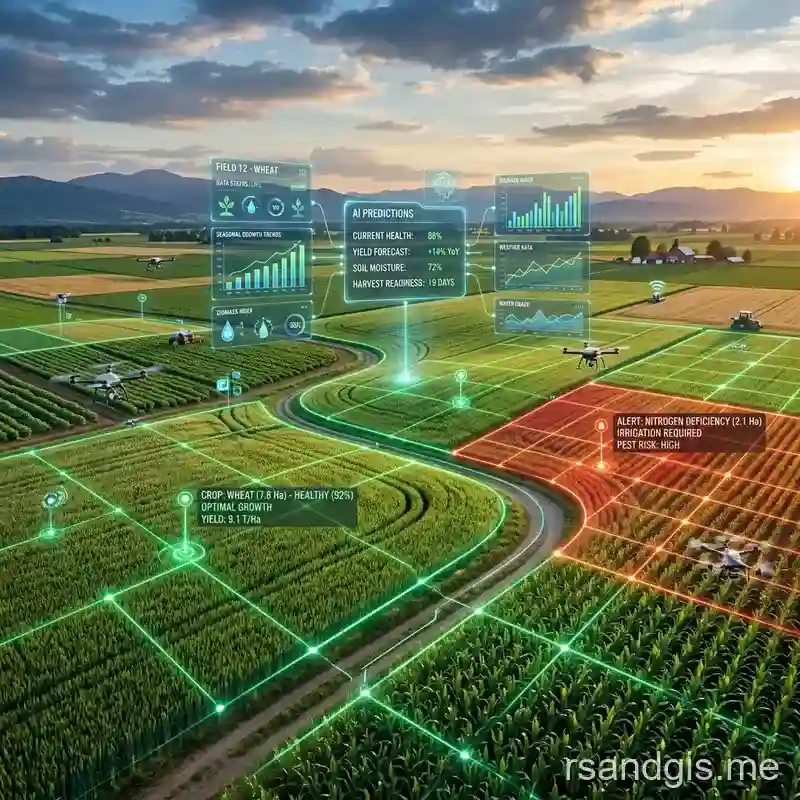
The evolution of machine learning crop yield prediction has fundamentally transformed precision agriculture by replacing empirical heuristics with data-driven predictive architectures. For decades, agronomists relied heavily on statistical regressions and mechanistic crop models like DSSAT (Decision Support System for Agrotechnology Transfer) or APSIM (Agricultural Production Systems sIMulator), which often struggled to capture the intricate, non-linear dynamics inherent in biological systems reacting to volatile environmental stimuli. The major shift toward computational agronomy leverages high-dimensional feature spaces, encompassing multispectral satellite imagery, hyper-local meteorological time-series, and granular physiochemical soil profiles. By projecting these heterogenous datasets into latent spaces, machine learning algorithms can approximate the underlying function mapping environmental inputs to phenotypic outputs, specifically, the harvestable biomass or yield. This article systematically dissects the state-of-the-art algorithmic frameworks, data fusion strategies, and deployment architectures driving the contemporary agricultural revolution, providing a comprehensive blueprint for researchers and practitioners in the agritech domain.
Introduction to Predictive Agronomy
Predictive agronomy is the scientific discipline of utilizing advanced mathematical modeling to anticipate crop performance long before the mechanical combine harvester ever enters the field. At its absolute core, the field seeks to systematically minimize the profound uncertainty associated with agricultural production, a sector inherently susceptible to stochastic weather events, catastrophic pest outbreaks, and continuously fluctuating soil nutrient availability. The ability to accurately forecast yield at a regional, farm, or sub-field level exerts a massive cascading impact across the global supply chain, influencing everything from local storage logistics to international commodity pricing and global food security interventions.
The Shift from Empirical Models
Historically, agrometeorological modeling relied heavily on linear assumptions and manually calibrated physiological parameters. These models, while highly interpretable and grounded in fundamental plant biology, possessed a rigid structural architecture that severely bounded their predictive capacity in dynamic environments. As the spatial and temporal resolution of agricultural data exploded with the simultaneous advent of affordable remote sensing platforms and in-field IoT (Internet of Things) deployments, these legacy systems began to exhibit severe underfitting, unable to digest the sheer volume and dimensionality of modern agronomic datasets.
Limitations of Traditional Agrometeorological Frameworks
Traditional modeling frameworks generally assumed a degree of stationarity in climate patterns, an assumption that is being increasingly violated by the erratic extremes brought on by anthropogenic climate change. Also, they required laborious, time-consuming calibration for specific genetic cultivars, localized microclimates, and unique farm management practices. The decisive transition to algorithmic machine learning modeling effectively mitigates these constraints by enabling models to autonomously learn intricate representations from raw, unstructured data without the need for explicit physiological programming. This self-learning capability allows for unparalleled pan-continental scalability and the ability to generalize robustly across varying agro-ecological zones, provided the underlying training corpus is sufficiently diverse, well-annotated, and representative of the target deployment domains.
Data Preprocessing and Feature Engineering Pipelines
Before any sophisticated machine learning architecture can be deployed, the raw agricultural data must undergo rigorous preprocessing. Agricultural datasets are notoriously noisy, characterized by missing values, sensor drift, and spatial inconsistencies. Building a robust preprocessing pipeline is often the most critical determinant of a model's ultimate predictive success.
Harmonizing Spatiotemporal Resolution
Agricultural data streams operate on fundamentally different spatiotemporal scales. A primary challenge in data preparation involves aligning these disparate sources into a uniform analytical grid that the machine learning model can digest without generating spatial artifacts or temporal leakage.
Interpolation and Resampling Techniques
Meteorological data, such as precipitation and solar radiation, is often collected at discrete weather stations that may be kilometers away from the target field. To generate field-level weather features, advanced geospatial interpolation techniques like Kriging or Inverse Distance Weighting (IDW) are employed to estimate values at unmeasured locations. Temporally, daily satellite imagery might need to be resampled using spline interpolation to fill gaps between orbital passes, ensuring a continuous time-series of vegetation indices (e.g., NDVI, NDRE) that accurately tracks the crop's phenological development through the vegetative and reproductive stages.
Handling Cloud Cover in Optical Imagery
Optical satellite platforms, such as the European Space Agency's Sentinel-2, provide incredibly valuable multispectral data, but they are fundamentally hampered by atmospheric occlusion. Cloud cover and cloud shadows introduce massive anomalies into the spectral reflectance time-series. Advanced preprocessing pipelines utilize sophisticated cloud-masking algorithms, such as Fmask (Function of mask) or deep-learning-based segmentation models, to identify and exclude contaminated pixels. Also, Synthetic Aperture Radar (SAR) data from satellites like Sentinel-1, which penetrates cloud cover, is increasingly fused with optical data to provide uninterrupted observations of canopy structure and soil moisture, ensuring model stability even during prolonged overcast periods.
Foundational Architectures in Yield Prediction
The earliest successful, highly commercialized applications of computational prediction in agriculture utilized robust, shallow learning algorithms. These techniques remain highly relevant today, particularly in niche scenarios where severe data sparsity precludes the training of deep neural networks, or where absolute model interpretability is a strict regulatory requirement for insurance underwriting or governmental reporting.
Supervised Learning Modalities
Supervised learning forms the theoretical backbone of yield forecasting, framed fundamentally as a highly complex multivariate regression problem where the ultimate target variable is a continuous scalar representing harvested mass per unit area (e.g., bushels per acre or tons per hectare).
Random Forests and Gradient Boosting Machines
Tree-based ensemble methods, notably Random Forests (RF) and advanced Gradient Boosting Machines (GBM) such as XGBoost, LightGBM, and CatBoost, have demonstrated exceptional, consistent efficacy across structured, tabular agronomic datasets. RF constructs a vast multitude of unpruned decision trees during the training phase, strategically injecting randomness through bootstrap aggregating (bagging) and randomized feature sub-setting at each nodal split. This highly uncorrelated ensemble severely curtails the high variance typical of single decision trees, preventing overfitting on noisy agricultural data. In direct contrast, GBMs operate sequentially, where each consecutive tree is explicitly and mathematically optimized to minimize the residual errors of its direct predecessor utilizing gradient descent optimization. In the specific context of crop yield, these boosting models are particularly adept at capturing critical threshold effects, such as the precise, non-linear inflection point where ambient temperature transitions from being optimal for photosynthesis to inducing severe, irreversible heat-stress, without requiring extensive manual feature scaling or complex polynomial transformations.
Support Vector Regression (SVR) in Non-Linear Yield Landscapes
Support Vector Regression utilizes the mathematical kernel trick to map low-dimensional input features into exceptionally high-dimensional Hilbert spaces. This mathematical projection facilitates the discovery of linear hyperplanes that correspond to highly complex, non-linear boundaries in the original feature space. By defining an epsilon-tube around the continuous target variable, SVR intelligently focuses solely on instances that fall outside this predefined margin (the so-called support vectors), conferring a massive degree of robustness against extreme outliers. Outliers are a ubiquitous, frustrating occurrence in agricultural data due to frequent sensor malfunction, GPS drift on harvesting equipment, or highly localized, anomalous weather events like hail strikes. The Radial Basis Function (RBF) kernel is predominantly employed in this domain, enabling the SVR model to learn highly localized, intricate interactions between localized soil chemistry metrics and localized precipitation patterns.
Deep Learning Paradigms for Spatiotemporal Data
As the volume, velocity, and variety of unstructured data, specifically optical satellite imagery time-series and high-frequency in-field sensor telemetry, exponentially increased over the past decade, the inherent limitations of manual feature engineering became a glaring bottleneck. Deep learning architectures circumvent this limitation entirely by autonomously performing hierarchical feature extraction, learning the most optimal representations directly from the raw data pixels.
Convolutional Neural Networks (CNNs) for Remote Sensing
Remote sensing data, primarily sourced from public constellations like Sentinel-2 and Landsat 8/9, or private constellations like Planet Labs, provides synoptic, multi-band observations of the Earth's agricultural surface. CNNs are uniquely mathematically suited to process this spatial topology due to their translation invariance and local connectivity patterns.
Multispectral and Hyperspectral Image Ingestion
Unlike standard consumer RGB imagery, agricultural remote sensing satellites capture data across a much broader swath of the electromagnetic spectrum, crucially including near-infrared (NIR), red-edge, and shortwave infrared (SWIR) bands. These specific wavelengths are highly sensitive to microscopic changes in chlorophyll fluorescence, canopy liquid water content, and internal leaf cellular structure. Standard 2D CNN architectures (like ResNet or EfficientNet) are fundamentally modified at the input layer to accept N-channel input tensors rather than just 3 channels. By applying a cascading series of spatial filters, the network hierarchical learns to detect simple edge features, complex textural patterns, and ultimately, profound agronomic phenomena such as irregular nutrient deficiency patches, nematode infestations, or the insidious propagation of drought stress across a heterogeneous field. Hyperspectral data, boasting hundreds of incredibly narrow, contiguous spectral bands, requires even more specialized 1D or 3D convolutions to prevent the mathematical curse of dimensionality while simultaneously extracting the granular spectral signatures that are entirely unique to specific crop varieties and microscopic stress conditions.
Temporal Feature Extraction using 3D Convolutions
Agriculture is an inherently biological and thus temporal process; the final state of a crop at the moment of harvest is a complex, cumulative function of its entire phenological lifecycle. To accurately capture the evolution of spatial features over an entire 150-day growing season, 3D Convolutional Neural Networks (3D-CNNs) are frequently deployed. By extending the convolutional kernel across the time dimension (generating a tensor of Height x Width x Time x Channels), the network can simultaneously extract spatial representations and track their temporal trajectories.
For instance, a well-calibrated 3D-CNN can automatically detect the precise rate of canopy senescence (the browning of leaves) prior to harvest, a critical physiological indicator that is heavily, negatively correlated with final grain weight and overall yield.
Recurrent Architectures for Time-Series Analysis
While CNNs excel at extracting rich spatial representations, Recurrent Neural Networks (RNNs) are explicitly optimized for processing sequential data streams, making them the undisputed architecture of choice for processing daily weather variables, continuous soil moisture telemetry, and calculated vegetation indices over time.
Long Short-Term Memory (LSTM) Networks for Phenological Tracking
Standard vanilla RNNs notoriously suffer from vanishing and exploding gradients when attempting to process very long sequences, such as an entire agricultural growing season. LSTMs elegantly solve this mathematically via a complex internal gating mechanism consisting of input, forget, and output gates that meticulously regulate the flow of information into a persistent internal cell state. In the context of yield prediction, this architecture allows the neural network to "remember" a severe, transient frost event that occurred during the early vegetative stage and correctly penalize the final yield prediction several months later, even if all subsequent growing conditions are mathematically optimal. This long-term memory capacity is absolutely crucial for modeling biological compensation mechanisms, where a resilient crop might recover vegetative mass from early-season stress but ultimately suffer from a permanently reduced reproductive yield ceiling.
Gated Recurrent Units (GRUs) in Meteorological Modeling
GRUs offer a highly computationally streamlined, efficient alternative to LSTMs by merging the forget and input gates into a single, unified update gate. In massive, large-scale regional or national yield forecasting deployments where millions of individual pixels or field boundaries must be processed simultaneously across computing clusters, GRUs very often provide highly comparable predictive accuracy with significantly reduced training time, faster convergence, and a lower memory overhead. They have proven particularly effective when integrating dense, high-frequency sequences of meteorological data (e.g., hourly temperature, precipitation, solar radiation, wind speed) where the most recent temporal context heavily and disproportionately dictates the immediate, minute-by-minute physiological transpiration response of the plant canopy.
Multimodal Data Fusion Strategies
The highest, most robust predictive accuracies in modern literature are achieved not by relying on a single data modality, but by the synergistic, intelligent integration of vastly disparate data streams. Multimodal deep learning aims to mathematically fuse spatial imagery, temporal weather data, static soil parameters, and even textual farm management logs into a single, cohesive predictive framework.
Integrating Heterogeneous Data Sources
The primary architectural challenge in multimodal fusion is harmonizing datasets with vastly different fundamental characteristics, dimensionalities, and signal-to-noise ratios.
Soil Grids and Topographical Feature Vectors
Inherent soil properties (such as pH, cation exchange capacity, bulk density, organic carbon content) and topographical features (elevation, slope, aspect, topographic wetness index) are generally considered static over a single agricultural growing season. These critical variables dictate the fundamental baseline yield potential and the complex hydrological flow of water across a field. In complex neural architectures, these static, tabular features are typically flattened into dense, multi-layer perceptron (MLP) feature vectors and then concatenated with the dynamic temporal or spatial embeddings generated by the recurrent or convolutional branches of the network.
Weather APIs and Microclimate Forecasting
Macro-weather data provided by regional airports often fails spectacularly to capture the actual microclimate experienced down at the physical canopy level. Advanced machine learning models ingest mathematically downscaled meteorological data, often derived from commercial weather APIs combined with ultra-high-resolution local terrain models. This enriched data provides the critical thermodynamic drivers, such as accumulated growing degree days (GDD) and vapor pressure deficit (VPD), that directly modulate the biological rate of crop development, photosynthesis, and water consumption.
Advanced Fusion Techniques
The specific architectural point at which different data modalities are mathematically combined significantly dictates the model's overall architecture and its ultimate predictive performance.
Early vs. Late Fusion Mechanisms
Early fusion (often termed data-level fusion) involves naively concatenating raw or minimally processed inputs together before feeding them into a single, monolithic network. This approach is highly problematic in agriculture due to vastly varying dimensionalities and conflicting scales. Late fusion (decision-level fusion) trains entirely independent models on each modality and then aggregates their final scalar predictions via averaging or voting. The current state-of-the-art methodology utilizes intermediate (or feature-level) fusion, where highly specialized, modality-specific encoders (e.g., a deep CNN for spatial imagery, an LSTM for sequential weather) generate high-level, dense latent representations. These rich embeddings are then concatenated and passed through a series of fully connected layers, allowing the network to learn profound cross-modal interactions, such as exactly how a specific, high-clay soil type physically mitigates the negative impact of a mid-season heatwave observed in the meteorological data stream.
Attention Mechanisms in Multimodal Transformers
The rapid advent of the Transformer architecture has fundamentally revolutionized multimodal fusion in predictive agronomy. Self-attention mechanisms allow the model to dynamically weight the importance of different modalities or specific temporal time steps on a case-by-case basis.
For example, a well-trained multimodal transformer can learn to autonomously apply extremely high attention weights to precipitation data during the hyper-critical silking or flowering stage of corn, while relying much more heavily on multispectral satellite imagery during the early vegetative canopy-closure phase. Cross-attention mechanisms further enable one modality to actively query another, dynamically refining the latent representations based on rich cross-domain contextual clues.
Model Evaluation and Uncertainty Quantification
Deterministic point predictions of yield are very often wholly insufficient for complex agricultural risk management, commercial insurance underwriting, and global commodity trading. End-users require a deep, statistically sound understanding of the model's confidence and the precise margins of error associated with the forecast.
Metrics for Regression Analysis
Standard regression evaluation metrics must always be interpreted strictly within the context of local agronomic baselines and historical averages. An absolute error of 0.5 tons per hectare might be perfectly acceptable for high-yielding, irrigated corn, but it would be considered catastrophic and practically useless for lower-yielding, dryland crops like soybeans, canola, or wheat.
Root Mean Square Error (RMSE) and Mean Absolute Error (MAE)
RMSE mathematically penalizes larger errors much more severely due to the squared term in its formula, making it the most appropriate metric when significant predictive deviations are economically costly (e.g., in regional food security assessments or derivatives trading). MAE provides a much more intuitive, linear interpretation of the average absolute error across all fields. In addition to these, the coefficient of determination (R-squared) evaluates the total proportion of statistical variance in the final yield that is successfully explained by the model's inputs. But these purely deterministic metrics provide absolutely no insight into the model's predictive confidence or reliability on unseen data.
Addressing Epistemic and Aleatoric Uncertainty
Uncertainty in crop yield prediction arises from two primary, distinct sources: epistemic uncertainty (model ignorance, lack of sufficient training data in specific regions) and aleatoric uncertainty (inherent, irreducible noise in the sensor data, unpredictable future weather events occurring after the prediction date).
Bayesian Neural Networks (BNNs) in Agriculture
BNNs mathematically replace deterministic, fixed network weights with complex probability distributions. During the inference phase, the network is sampled multiple times using Markov Chain Monte Carlo (MCMC) or variational inference methods to generate a full predictive distribution rather than a single point estimate. The variance of this resulting distribution rigorously quantifies the model's epistemic uncertainty. In operational yield forecasting, a BNN will intelligently output a much wider confidence interval for a field experiencing unparalleled, anomalous climatic conditions that were not present in the historical training set, directly signaling to the agronomist or underwriter that the prediction is mathematically less reliable.
Monte Carlo Dropout for Predictive Confidence
As a highly computationally efficient alternative to full Bayesian Neural Networks, Monte Carlo (MC) Dropout involves intentionally leaving dropout layers active during the testing or inference phase. By performing dozens or hundreds of forward passes on the exact same input tensor, each time with a slightly different random set of temporarily deactivated neurons, an ensemble of diverse predictions is quickly generated. The mean of these predictions serves as the expected yield, while the variance provides a highly actionable, robust metric of uncertainty. This specific technique is absolutely critical for crop insurance companies assessing the exact risk premium for a specific, localized parcel of land.
Edge Computing and Real-Time Inference
The ultimate, practical utility of advanced predictive models relies almost entirely on their seamless integration into operational farming workflows. Relying solely on remote cloud-based inference introduces unacceptable latency and a total dependency on robust cellular internet connectivity, which is often severely lacking, intermittent, or non-existent in remote rural agricultural zones across the globe.
Deploying Models on IoT Devices
The massive push towards agricultural edge computing involves deploying highly optimized, lightweight machine learning models directly onto field-level agricultural hardware, such as autonomous variable-rate tractors, low-altitude drone payloads, or stationary in-field environmental sensor nodes.
Model Quantization and Pruning
Deep neural networks are notoriously computationally and memory intensive. Model quantization mathematically reduces the precision of the network weights and activations (e.g., converting from high-precision 32-bit floating-point arithmetic to highly efficient 8-bit integers), drastically shrinking the memory footprint by up to 4x and radically accelerating inference speed on edge CPUs with minimal, often imperceptible loss in predictive accuracy. Network pruning involves systematically analyzing and eliminating redundant or mathematically less-important neural connections and entire filters. These advanced compression techniques enable highly complex CNNs or LSTMs to execute flawlessly in real-time on low-power microcontrollers (like Raspberry Pi or NVIDIA Jetson Nano), allowing a smart-sprayer equipped with computer vision to dynamically adjust its chemical application rate based on localized yield potential predicted entirely on-the-fly, field-side.
Federated Learning Across Disconnected Farms
Commercial data privacy is a massive, paramount concern for modern, large-scale farming operations that closely guard their yield maps and management practices. Federated learning allows powerful models to be trained collaboratively across completely decentralized edge devices without ever exchanging or centralizing raw, proprietary data. A global, base yield prediction model is securely distributed to local, secure farm servers. Each farm's server then fine-tunes the model locally using its own highly proprietary, high-resolution on-farm data. Only the mathematically updated model gradients or weights, never the raw yield maps or management data, are encrypted and sent back to the central server for secure aggregation. This paradigm rigorously preserves data sovereignty and privacy while still allowing the entire network to benefit from the collective, generalized intelligence derived from millions of hectares of diverse agricultural data.
Future Directions and Agronomic Implications
The long-term trajectory of computational agronomy is aggressively moving toward prescriptive, rather than purely predictive, analytical frameworks. The ultimate goal is no longer just to passively forecast the final yield, but to algorithmically and dynamically determine the exact, optimal sequence of management interventions required to maximize that yield while minimizing costly inputs.
Integration with Autonomous Farming Systems
Yield prediction models are rapidly becoming the central, intelligent "brain" of next-generation autonomous agricultural systems. By continuously updating yield forecasts on a daily basis based on real-time sensor data streams, these systems can dynamically and autonomously allocate scarce resources.
Yield-Driven Variable Rate Prescriptions
Highly accurate, mid-season yield predictions generate incredibly granular spatial maps of production potential. These digital maps are then directly and automatically translated into Variable Rate Application (VRA) machine-code files for automated, GPS-guided farm machinery. If a predictive model determines that a specific micro-zone within a larger field has a severely constrained yield ceiling due to permanently poor soil water retention capabilities, the VRA system will automatically reduce the application of expensive nitrogen fertilizer in that specific zone, significantly optimizing the economic return on investment and drastically minimizing harmful environmental nutrient runoff into local watersheds. Conversely, zones identified as having exceptionally high potential based on optimal soil and weather interactions automatically receive increased inputs to fully maximize their output. This intelligent, closed-loop system, governed entirely by sophisticated machine learning, represents the absolute zenith of modern precision agriculture.
Ethical and Socioeconomic Considerations
As machine learning crop yield prediction models become increasingly commercialized and integrated into the global agricultural economy, numerous profound ethical and socioeconomic challenges emerge that must be critically addressed by developers and policymakers alike.
The Digital Divide and Algorithmic Equity
The development of high-fidelity predictive models relies heavily on access to massive quantities of high-quality, ground-truthed data. This reality inherently advantages large, well-capitalized corporate farming operations situated in developed nations, which possess the financial resources to deploy extensive sensor networks and modern harvesting equipment equipped with precise yield monitors. In stark contrast, smallholder farmers in developing regions, who arguably stand to benefit the most from yield optimization and risk mitigation tools, often operate in data-poor environments. If predictive agronomy exclusively serves data-rich regions, it risks exacerbating existing global inequalities, creating a severe technological divide where advanced insights are hoarded by a privileged few, leaving vulnerable farming communities mathematically marginalized.
Democratizing Access to Predictive Models
Addressing this inequity requires a concerted effort to democratize access to both the underlying data and the trained algorithmic models. Initiatives focused on open-source agricultural datasets, such as the Radiant Earth Foundation, are critical in providing the necessary training corpus for models targeting underserved geographies. Also, the deployment of lightweight, mobile-friendly applications that can run inference on localized, low-bandwidth networks is essential for delivering actionable insights to smallholder farmers, ensuring that the benefits of machine learning crop yield prediction are distributed equitably across the global agricultural spectrum.
Conclusion
The application of machine learning to crop yield prediction is a rapidly maturing, highly interdisciplinary field that sits precisely at the intersection of advanced computer science, environmental biophysics, and modern agricultural engineering. As next-generation satellite constellations launch higher-resolution, more frequent sensors, and as algorithmic deep learning architectures continue to evolve to better handle multimodal, spatiotemporal complexities, the baseline accuracy and spatial granularity of these agricultural predictions will inevitably continue to improve. The ongoing, grand challenge for the next decade lies not merely in incremental algorithmic refinement in a laboratory setting, but in the seamless, robust deployment of these powerful predictive tools directly into the hands of working agronomists and global food producers, definitively transforming theoretical data science into tangible, sustainable, and critically needed gains in global food production capacity.
Frequently Asked Questions
How is machine learning used to predict crop yields?
Machine learning models combine historical yield data, weather patterns, soil conditions, and real-time satellite imagery to recognize complex patterns and forecast crop production months before the actual harvest.
Which satellite data is most important for crop prediction?
Time-series multispectral data (like NDVI derived from Landsat or Sentinel-2) is critical because it tracks the growth trajectory and health of the crop canopy throughout the entire growing season.
What are the benefits of accurate crop yield forecasting?
Accurate forecasting allows farmers to optimize fertilizer and water usage, helps agricultural commodity markets stabilize prices, and enables governments to preemptively manage food security and supply chain logistics.