Advanced Real Time Traffic Routing Algorithms
Table of Contents
- Introduction to Dynamic Network Topologies
- The Limitations of Classical Dijkstra and A*
- Paradigm Shift: Anticipatory Routing
- Multi-Agent Deep Reinforcement Learning (MADRL) Integration
- State Space and Action Space Formulations
- Continuous vs. Discrete Action Spaces
- Reward Function Engineering
- Graph Convolutional Networks (GCN) for Spatial Dependencies
- Spectral Graph Convolutions in Traffic
- Spatiotemporal Attention Mechanisms
- Quantum-Inspired Metaheuristics for Global Optimization
- Quantum Particle Swarm Optimization (QPSO)
- Wave Function Collapse in Route Selection
- Entanglement-Based Vehicle Coordination
- Hybridizing QPSO with MADRL
- Real-World Implementation Challenges
- Latency and Edge Computing Constraints
- Federated Learning on Edge Devices
- Data Sparsity and Imputation Techniques
- Future Trajectories in Traffic Optimization
- V2X Communication Protocols
- Autonomous Fleet Coordination
- Conclusion
- Frequently Asked Questions
rsandgis.me
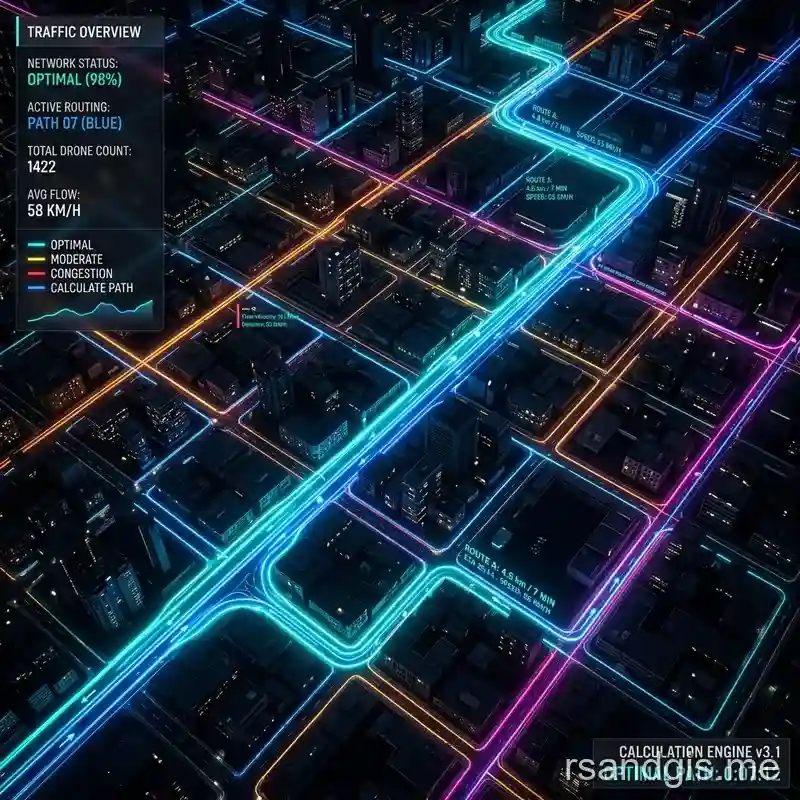
The evolution of urban mobility has necessitated the development of sophisticated real time traffic routing algorithms to manage the exponentially increasing complexity of vehicular networks. As metropolitan areas expand and the density of interconnected vehicles grows, traditional methods of traffic management and route optimization are rapidly becoming obsolete. The modern transportation ecosystem, characterized by fluctuating congestion patterns, heterogeneous vehicle types, and unpredictable environmental variables, requires dynamic, adaptable, and highly resilient computational strategies. In this comprehensive technical exploration, we will explore the cutting-edge methodologies that define contemporary routing engines, focusing on the synergistic integration of Multi-Agent Deep Reinforcement Learning (MADRL) and Quantum-Inspired Metaheuristics to solve Non-deterministic Polynomial-time hard (NP-hard) routing problems in ultra-dense urban topologies.
Introduction to Dynamic Network Topologies
In graph theory, a vehicular network is typically modeled as a directed graph where nodes represent intersections and edges represent road segments. The fundamental challenge lies in the dynamic nature of edge weights. Unlike static routing problems where traversal costs (e.g., distance or free-flow travel time) are constant, real-world traffic networks feature time-varying, stochastic edge weights. These weights represent the actual travel time, which is a non-linear function of traffic density, vehicular speed variance, weather conditions, and discrete events such as accidents or signal phase and timing (SPaT) changes.
The Limitations of Classical Dijkstra and A*
Classical shortest path algorithms, such as Dijkstra's algorithm and the A* search algorithm, rely on the assumption of static or quasi-static edge weights. Dijkstra's algorithm guarantees the discovery of the shortest path by systematically relaxing edges, expanding outward from the origin node in a uniform manner. While variations like Time-Dependent Dijkstra (TDD) attempt to incorporate temporal variations by modeling edge weights as piecewise linear functions of time, they inherently struggle with the curse of dimensionality when subjected to high-frequency, stochastic updates typical of modern smart city sensor networks.
Similarly, the A* algorithm employs a heuristic function to guide the search process, significantly reducing the number of explored nodes. But the efficacy of A* is critically dependent on the admissibility and consistency of its heuristic. In a highly volatile traffic environment, maintaining a tight, admissible heuristic without underestimating the rapidly changing costs is mathematically intractable for large-scale graphs. Also, both algorithms operate deterministically and are inherently myopic; they optimize the route for a single ego-vehicle without considering the macroscopic systemic impact. If a classical algorithm reroutes a massive fleet of vehicles to a newly discovered optimal path, it invariably induces artificial congestion on that very path, a phenomenon known as the "Braess's paradox" or routing oscillation.
Paradigm Shift: Anticipatory Routing
To overcome these systemic failures, the industry is shifting towards anticipatory routing paradigms. These systems do not merely react to current congestion states; they probabilistically forecast future network states based on historical spatiotemporal data, current inflow rates, and the projected trajectories of all active vehicles within the system. Anticipatory routing frameworks typically employ recurrent neural architectures, such as Long Short-Term Memory (LSTM) networks or Gated Recurrent Units (GRUs), coupled with macroscopic traffic flow models like the Cell Transmission Model (CTM) or the Lighthill-Whitham-Richards (LWR) kinematic wave model. By integrating predictive analytics directly into the routing engine, vehicles can be proactively dispersed across alternative routes before localized congestion bottlenecks actually materialize, thereby achieving a state approaching Wardrop's User Equilibrium or, ideally, System Optimal conditions.
Multi-Agent Deep Reinforcement Learning (MADRL) Integration
The formulation of the traffic routing problem as a Markov Decision Process (MDP) enables the application of Deep Reinforcement Learning (DRL). Given the presence of thousands of concurrent routing requests, treating the entire system as a single agent leads to exponential state-action space explosion. Thus, Multi-Agent Deep Reinforcement Learning (MADRL) emerges as the de facto architecture for distributed, cooperative routing optimization.
State Space and Action Space Formulations
In the MADRL framework, each autonomous vehicle or centralized regional controller is modeled as an independent agent interacting with a shared environment. The state space observed by an agent at any discrete time step typically comprises localized congestion metrics, relative distances to destination nodes, the spatial distribution of neighboring agents, and real-time SPaT data from upcoming intersections. This localized observability transforms the underlying mathematical model from a standard MDP into a Partially Observable Markov Decision Process (POMDP).
Continuous vs. Discrete Action Spaces
The definition of the action space dictates the algorithmic approach. If agents control steering angles and acceleration vectors directly, the action space is continuous, necessitating policy gradient methods such as Deep Deterministic Policy Gradient (DDPG) or Soft Actor-Critic (SAC). But in the context of macroscopic routing, the action space is generally discrete, specifically, selecting the next node or edge sequence from a finite set of valid outgoing connections at an intersection. This discrete formulation is highly conducive to value-based methods, particularly variants of the Deep Q-Network (DQN) algorithm. To mitigate the overestimation bias inherent in standard DQN, Double DQN (DDQN) combined with Prioritized Experience Replay (PER) is frequently deployed, allowing agents to preferentially learn from routing decisions that resulted in high temporal discrepancies from expected outcomes.
Reward Function Engineering
The convergence of MADRL policies relies entirely on the precise calibration of the reward function. A naive reward structure focusing exclusively on minimizing individual travel time often leads to selfish routing behaviors, culminating in severe network-wide congestion gridlocks. Therefore, advanced reward functions must incorporate a delicate balance between individual utility and global efficiency. This is often achieved through a linearly weighted summation of terms: a high positive reward for reaching the destination, a persistent negative step penalty to incentivize speed, and a collective penalty proportional to the variance in density across local road segments to promote load balancing. Also, to address the credit assignment problem in cooperative MADRL, where agents struggle to determine how their individual actions contributed to a global reward, techniques such as difference rewards or the use of centralized critics (as seen in Multi-Agent Deep Deterministic Policy Gradient, MADDPG) are essential.
Graph Convolutional Networks (GCN) for Spatial Dependencies
Standard Multi-Layer Perceptrons (MLPs) or Convolutional Neural Networks (CNNs) fail to adequately capture the non-Euclidean, topological structure of road networks. Graph Convolutional Networks (GCNs) solve this by generalizing convolution operations to graph-structured data. By embedding GCNs into the feature extraction pipeline of the MADRL agent, the state representation becomes highly sensitive to the topological interconnectedness of the traffic grid.
Spectral Graph Convolutions in Traffic
Spectral GCNs perform convolutions in the Fourier domain by utilizing the eigendecomposition of the graph Laplacian. Let the graph be represented by an adjacency matrix and a degree matrix. The normalized graph Laplacian is calculated, and its eigenvectors provide a set of orthogonal bases for the graph signal. Filtering operations are then applied to these spectral components, enabling the model to learn localized patterns of congestion propagation.
For instance, a spectral convolution can smoothly model how a shockwave of braking vehicles propagates backwards through a sequence of connected edges, adjusting the learned state representation long before the congestion reaches the ego-vehicle's immediate vicinity.
Spatiotemporal Attention Mechanisms
To capture the intricate interplay between space and time, modern architectures fuse GCNs with self-attention mechanisms, forming Spatiotemporal Graph Attention Networks (ST-GAT). The spatial attention block dynamically computes the importance weights of neighboring nodes based on their hidden state representations, allowing the routing agent to focus exclusively on arterial roads that heavily influence travel times while ignoring minor cross-streets with negligible impact. Simultaneously, temporal attention blocks identify long-range temporal dependencies, correlating recurring daily congestion patterns with real-time anomalies. This dual-attention architecture provides a robust, highly expressive state embedding that significantly accelerates the convergence of the downstream RL policy.
Quantum-Inspired Metaheuristics for Global Optimization
While MADRL excels at learning localized policies, coordinating a fleet of thousands of vehicles to achieve a true global System Optimal (SO) state remains a formidable challenge prone to local optima traps. To inject global exploration capabilities, researchers are increasingly hybridizing neural approaches with Quantum-Inspired Metaheuristics, specifically leveraging the mathematical principles of quantum mechanics, such as superposition and entanglement, within classical computational frameworks.
Quantum Particle Swarm Optimization (QPSO)
Traditional Particle Swarm Optimization (PSO) simulates the social behavior of a flock of birds, where each particle represents a candidate routing solution in an N-dimensional search space. Particles update their velocities and positions based on their personal best known position and the global best position found by the entire swarm. But classical PSO is notorious for premature convergence when applied to highly multimodal traffic optimization landscapes.
Wave Function Collapse in Route Selection
Quantum Particle Swarm Optimization (QPSO) replaces classical Newtonian kinematics with quantum mechanical probability amplitudes. In QPSO, the position of a particle (representing a multi-vehicle routing strategy) is no longer a deterministic point but rather a probability density function defined by a wave function, typically modeled using the Schrödinger equation for a delta potential well. The precise routing state is determined only upon measurement (collapse of the wave function). This inherent probabilistic structure guarantees that all regions of the search space possess a non-zero probability of being explored, mathematically ensuring global convergence as time approaches infinity. In practice, this allows the routing algorithm to discover highly unconventional, globally optimal detours that classical gradient descent or standard PSO would definitively discard as suboptimal early in the search process.
Entanglement-Based Vehicle Coordination
To further enhance multi-vehicle coordination, quantum-inspired algorithms utilize simulated entanglement to bind the states of tightly coupled vehicles. If a group of vehicles forms a platoon destined for a similar geographical sector, their corresponding "particles" in the optimization space become mathematically entangled. A permutation in the routing strategy of the lead vehicle instantaneously updates the probability amplitudes of the trailing vehicles' routing options, bypassing the latency associated with iterative message passing. This entanglement-based heuristic profoundly accelerates the generation of conflict-free, synchronized routing plans, particularly at complex intersections requiring fine-grained cooperative scheduling.
Hybridizing QPSO with MADRL
The ultimate frontier in algorithmic routing is the hybridization of these disparate paradigms. In a typical hybrid architecture, the QPSO algorithm functions as a global meta-optimizer for the MADRL agents. The weights of the neural networks governing the MADRL policies constitute the optimization variables for the quantum particles. The QPSO iteratively explores the vast weight space, utilizing its quantum-behaved exploration properties to escape saddle points and local minima. Once a promising region of the parameter space is identified via wave function collapse, conventional gradient-based RL algorithms fine-tune the localized routing policies. This memetic approach yields routing agents that are both globally aware and locally reactive, possessing the capability to navigate unparalleled levels of urban traffic density with near-optimal efficiency.
Real-World Implementation Challenges
Despite the immense theoretical promise of these advanced algorithmic structures, deploying them in live, real-world urban environments introduces a spectrum of formidable engineering and infrastructural challenges that require sophisticated mitigation strategies.
Latency and Edge Computing Constraints
Real-time traffic routing necessitates millisecond-level decision-making. Transmitting high-dimensional state data from millions of vehicles to a centralized cloud server for MADRL inference and QPSO optimization introduces unacceptable round-trip latency and risks catastrophic failure due to network bandwidth saturation. As a result, computation must be decentralized and pushed towards the network periphery using Multi-Access Edge Computing (MEC) infrastructure. Edge nodes, co-located with cellular base stations or traffic signal controllers, execute localized routing inferences, significantly reducing latency and ensuring high-availability operations even during transient backhaul network outages.
Federated Learning on Edge Devices
To continuously train the deep routing models without violating user privacy by uploading raw trajectory data, Federated Learning (FL) is employed. Each edge node, or even high-compute autonomous vehicles themselves, trains localized models on their proprietary spatiotemporal data. Only the resulting cryptographic model weight updates, not the raw location data, are transmitted to an aggregation server. The server utilizes secure multiparty computation to average these updates, producing an improved global routing policy that is subsequently broadcasted back to the edge. This federated architecture guarantees that the real time traffic routing algorithms evolve continuously while maintaining strict adherence to stringent global data privacy regulations.
Data Sparsity and Imputation Techniques
A critical vulnerability of deep learning-based routing engines is their reliance on dense, high-fidelity data streams. In reality, sensor networks suffer from frequent outages, transmission packet loss, and severe spatial sparsity (e.g., lack of smart infrastructure in suburban outskirts). To maintain algorithmic robustness, sophisticated data imputation techniques are requisite. Generative Adversarial Networks (GANs) and Variational Autoencoders (VAEs) are deployed to reconstruct missing traffic flow matrices. By learning the underlying manifold of historical traffic patterns, these generative models can accurately synthesize highly plausible spatiotemporal states for unmonitored road segments, ensuring that the MADRL agents do not make erratic routing decisions based on corrupted or incomplete environmental observations.
Future Trajectories in Traffic Optimization
Looking ahead, the evolution of algorithmic routing will be intrinsically linked to advancements in vehicular communication protocols and the broader deployment of fully autonomous fleets, unlocking new dimensions of optimization that are currently theoretical.
V2X Communication Protocols
Vehicle-to-Everything (V2X) communication standardizes the real-time exchange of telemetry data between vehicles (V2V), infrastructure (V2I), and pedestrians (V2P). The integration of Dedicated Short-Range Communications (DSRC) and 5G/6G Cellular V2X (C-V2X) will transform the underlying assumptions of current routing algorithms. Instead of relying on delayed sensor aggregations, routing engines will leverage ultra-low latency, peer-to-peer data streams to perform instantaneous micro-routing adjustments, negotiating lane changes and intersection access dynamically without central arbitration.
Autonomous Fleet Coordination
As the penetration rate of Level 4 and Level 5 autonomous vehicles increases, the stochastic human element, responsible for phantom traffic jams and erratic braking, will diminish. This will allow routing algorithms to transition from predictive, probabilistic models to highly deterministic, scheduling-based frameworks. Fleets of autonomous vehicles will operate as cohesive, synchronized swarms, utilizing real-time traffic routing algorithms to execute complex maneuvers like high-speed platooning and continuous-flow intersection crossings, theoretically pushing the capacity of existing road networks to their absolute physical limits.
Conclusion
The transition from classical shortest-path heuristics to advanced, AI-driven routing methodologies represents a fundamental major shift in intelligent transportation systems. By fusing the spatial awareness of Graph Convolutional Networks, the strategic decision-making of Multi-Agent Deep Reinforcement Learning, and the global optimization capabilities of Quantum-Inspired Metaheuristics, researchers are forging a new generation of computational tools capable of taming the chaos of urban mobility. While substantial challenges remain in edge deployment and data fidelity, the continued refinement of these real time traffic routing algorithms stands as an imperative endeavor, promising a future of sustainable, highly efficient, and globally optimized intelligent transportation networks.
Frequently Asked Questions
How do real-time traffic routing algorithms work?
Real-time traffic routing algorithms, like dynamic A* (A-star) or Dijkstra's algorithm, continuously update the 'cost' (travel time) of road network segments (edges) based on live traffic congestion data, constantly recalculating the fastest path.
What is the A* (A-star) algorithm?
A* is a highly efficient pathfinding algorithm widely used in GIS. It improves upon Dijkstra's algorithm by using a 'heuristic' (like the straight-line distance to the destination) to prioritize which paths to explore, drastically speeding up route calculation.
How is live traffic data integrated into routing engines?
Live traffic data is typically ingested via APIs from crowdsourced GPS data or road sensors. This data is converted into dynamic penalty values assigned to the road network graph, forcing the algorithm to find alternative routes around heavy congestion.